
Kitchen Forkup: Fermented Foods
Leave a commentKirsten Mortensen Says:
Okay, I’ll go!!!
Yesterday evening I threw out a gigantic pile of sliced cabbage that was supposed to have turned into sauerkraut . . . not sure what happened but after 10 days it still wasn’t sour . . . not even particularly acidic. I may have over-salted . . .
I admire your effort here, Kirsten. Eating fermented foods is getting a lot of praise recently: lactic acid-fermentation like this breaks down the carbohydrates in the cabbage and is supposed help digestion as well as fight cancer. And sauerkraut is loaded with nutrients, calcium being one of them. (Ladies– take note. Eat pickled cabbage for strong bones!)
This happened to me once with quarts and quarts of sour pickles. I had to toss most of my cucumber harvest. Heartbreaking. Why? I didn’t rinse/pat them dry after the salting stage– the long, kosher-salted slices must sit in a large bowl with a plate or weight on top and “weep” out their liquid, and I failed to rinse and dry.
So you may be right about too much salt. Or too much liquid. What kind of salt did you use? Kosher or pickling salt is really required.
Was this “raw” pickled sauerkraut, or the old traditional cooked recipe? Did you add whey? Pound it? Was it supposed to sit for 2 weeks, 3 days, or was this a quick preparation that was ready in a few hours? I’d love to see the recipe.
Moisture, amount of oxygen, and temperature are all important factors in determining the outcome. For a great scientific explanation of how sauerkraut ferments, see:
http://www.nourishingtreasures.com/index.php/2012/05/15/the-science-behind-sauerkraut-fermentation/
(scroll down page)
Kitchen Philosopher: Experience Food For Yourself
2 Comments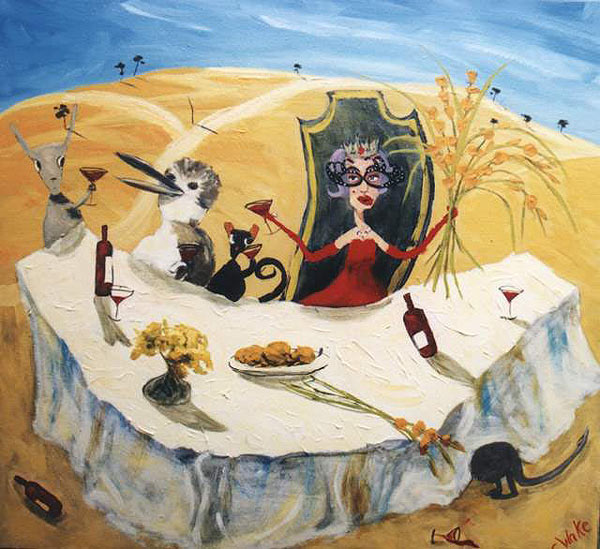
“Never eat the same meal twice.
If you want to be knowledgeable about food,
you need to experience it yourself.”
–Amanda Hesser
Talking Measuring Cup
2 CommentsTALKING MEASURING CUP WON’T RUNNETH OVER
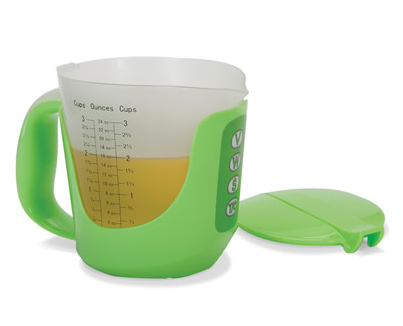
Hammacher Schlemmer, the high end department store for people with money to burn and an extreme obsession with gadgetry, is now offering a talking measuring cup. Its unbreakable plastic construction holds up to three cups of whatever you need to measure.
This sophisticated device reads and announces the amount of either wet or dry ingredients in the cup by discerning density and then reports the amount in cups, milliliters, or by weight.
Throw it in the microwave with confidence and into the dishwasher for easy clean up. This user-friendly item sports a flip-up lid and yes, as you probably guessed, requires two AAA batteries to operate.
While the talking cup may seem like a frivolous kitchen gadget for most cooks, it offers advantages to individuals with compromised vision or other disabilities. What cook wouldn’t want a lovely, soothing female voice as accompaniment to odious measuring tasks? And if your chatty GPS device is lonely and looking for companionship, why not pick up one of these chatty gadgets for a mere $59.99? Batteries not included.
–MELorden
Cowboy Cooking
6 CommentsBUSTING MYTHS ABOUT FOOD ON THE FRONTIER
Ahh. Nothing like sitting around the campfire under a starry night. You lean up against your saddle, take out your mess kit, and pony up to the old chuck wagon on your tired, bowed legs. You give Cookie a smirk and receive your reward for a rough and tumble day of cow punching– a rusty ladle of beans. Yessiree.
When your team of cattle drovers reaches the nearest town, the cook visits the general store to load up on big burlap bags of more beans, coffee, sugar, flour, and of course, whiskey– the staples of the cowboy diet. Shades of Blazing Saddles, Rawhide, and John Ford westerns? Since this image of cowboy fare is both comical and romanticized, let’s take a look at what really constituted cowboy grub.

Guarding the larder
Cowboy is a catch-all term for those nomadic workhands who herded cattle across the plains of the American west during the mid to late 19th century. Cattle herding and driving, however, had its American roots among the Irish in Boston in the early 1700′s and then in the grazing culture of the South before it moved westward onto the Great Plains. Cities like Baltimore and Philadelphia certainly enjoyed their cuts of beef as drovers brought cattle to slaughter in the mid-Atlantic states (Weaver, America Eats). Following the US government’s mandate to exterminate both Indians and the buffalo after the Civil War, the practice of raising and breeding cattle blossomed along with the conquest of the western plains. Cattle ranching and husbandry were considered a superior pursuit compared to the hunting and gathering life ways of the indigenous peoples. Infamous cowtowns like Abilene, Wichita, Omaha and Chisolm through which Texas herders drove their Longhorns emerged. By the mid- 1880′s, 6 million head of cattle were driven north by cowhands to the railroad hubs en route to Chicago’s slaughterhouses (Civetello, Cuisine and Culture). As the desire for cheap beef grew, laborers on horseback were in great demand.
The cowboy diet was the fare of the working man. No filet mignon for him. For the hardscrabble cowboy, the number one concern was a full stomach for the 2 to 5 month drive. Like most nomads, cowboys carried a lot of their foodstuffs with them in the form of dehydrated beef (jerky) and hardtack, or they were scavengers on the trail. In fact, beef was generally not the central focus since its value was in its sale, and when served, it was often in the form of a stew composed of the less pricey cuts and odd bits– or the “chuck”.
The name “Chuck” derived from 17th Century England…meat merchants who referred to their lower priced goods as “Chuck”. By the 18th Century, the term “chuck” was communicated towards good hearty food. (Chuckwagon Cooking: History, web)
And it wasn’t until after the Civil War, in 1866, that a clever cattleman by the name of Charles Goodnight transformed an old surplus army wagon into a rolling pantry. With the addition of a hinged door that flipped into a table, some drawers and shelves inside the wagon bed for canned goods (like tomatoes and peaches for vitamin C to fight scurvy), and a storage boot for pots and pans, the chuck wagon was born. The manufacturer was Studebaker, and the company went on to produce several more sophisticated models. Who knew that the workhorse larder for the cowpoke was the ancestor of the four-door sedans of the mid-twentieth century American family? After the creation of the chuck wagon, cowboys ate measurably better.
Want to learn how to cook like a modern cowboy? You can go to camp and learn how. Check out the Kent Rollins’ Dutch Oven Cooking School:
What was the typical day for the chuck wagon master like? He didn’t just cook. He cut hair, nursed wounds, did mechanical repairs,and managed accounts along with preparing and rationing foods: grinding coffee, making biscuits, tending the sourdough starter, and carving the salt pork. His tasks included setting up camp, tending the fire, preparing meals using dutch ovens and skillets, and cleaning up.. He was paid well for it– significantly more than the cowboys.
Fresh eggs or vegetables sometimes would be available as the trail boss [would] authorize trading a steer with some farmer along the trail drive… the daily norm was dried pork, beans and bread with the choice of water or coffee to drink. (Chuckwagon Cooking: History, web)
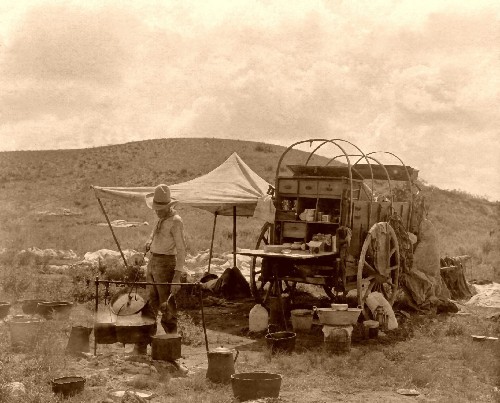
Because the cowboy population was made up of many immigrant cultures, their food reflected the combined and often looked-down-upon culinary habits of the Irish, African, South American, Chinese, and Spanish cultures. Chile was the go-to spice for Cookie. Today when you encounter cookbooks that contain old-timey , genu-ine cowboy recipes, they often reflect the influences of these various cuisines. You might find some great recipes for Rocky Mountain Oysters (bulls testicles), Sancocho de Cola de Res (Ox tail stew), and all manner of corn biscuits and tortilla-based fare, and the ubiquitous frijoles– yes, beans.
Beware cookbooks that hail authentic cowboy meals in the form of a cast iron skillet Chicken Cordon Bleau or Chicken & Cheese Chimichangas because the real cowboys were having none of that. Funny now to see how these delicacies rustled up in an old cast iron dutch oven or skillet are considered authentic and iconic cuisine.
Maybe that miserable meal of beans and burnt coffee isn’t so far off the mark after all. The chuck wagon master probably slept with his Remington by his side many a night after the last tin cup and spider were washed and stored. –MELorden
RECIPES
Time to saddle-up and get out the old skillet and give these cowboy victuals a try. They are sure to put hair on your chest.
For a selection of reinterpreted cowboy recipes, see:
http://www.recipegoldmine.com/cowboy/cowboy.html
For a look at the more realistic and dismal side of cowboy fare, see:
http://www.legendsofamerica.com/we-frontierrecipes.html
http://artofmanliness.com/2009/08/15/cowboys-recipes-thatll-put-hair-on-your-chest/
Waste Not Want Not
Leave a commentTHE WORLD WASTES 50% OF AVAILABLE FOOD
While almost one billion mouths suffer from hunger worldwide, many fields with unharvested crops lie rotting. Laws dictating tossing out foods with expired sell-by dates result in the dumping of perfectly good food sources. And less-than-perfect fruits and vegetables headed for grocery store shelves end up in the trash heap.

So says a recent study by GB’s Institution of Mechanical Engineers which calculates that nearly “2 billion tons of food produced worldwide never makes it into a consumer’s mouth.” (LA Times) The study, which predicts the need to feed an additional 3 billion mouths by 2075, blames the “supply chain”, an infrastructure rife with inadequacies of transportation, agricultural practices and inefficiencies such as poor storage facilities and packaging along with misused natural resources of water, land, and energy. IME also points a finger at both retailers and consumers.
If produce isn’t attractive or unblemished, most consumers will by-pass it, observes the study, which identifies US and European consumers as a group that dumps about half of all food they buy. With such overwhelming waste and inefficiency in the production and distribution of potentially viable and still nutritious foodstuffs, world hunger will continue to grow. Changes in process and infrastructure along with transforming the consumer mind-set are solutions to end world hunger and could up the potential to feed the world by 60%-100% (Canarian Weekly). The IME is calling for immediate action to address this growing crisis of waste and hunger. —MELorden
Fast Flank Steak
Leave a commentA recent trend in cookbooks is the quick-and-easy, fast-and-simple approach to cooking. The thirty minute meal is nearly passé as some of the most glamorous chefs in the business are writing accessible, user-friendly, and super speedy recipe books for the home chef. Popular now is a “1-2-3″ approach and poof! You have a great meal on the table that is fine enough for entertaining.
So here is a fast and fabulous recipe that I put together in the spirit of “1-2-3″ for a great and versatile cut– the flank steak.
I wanted to find a way to stop second guessing whether the steak was really done. In my early experiences with flank, I was destroying it by over cooking it into a tough, tasteless, and gray chewfest. This anxiety about killing the cut eventually led to undercooking it. The outside looked perfect and the inside remained a very bloody, lukewarm mess. How to know?
The primary objective of the following recipe is not speed, though it does qualify as a 1-2-3 recipe. I’ve just tweaked the name to 2-2-2 Marinated Flank Steak, and you’ll see why. It’s easy to remember this recipe as it’s mostly about technique, not ingredients.
In fact, you might be surprised to find out how to get the perfectly seared and moistly cooked marinated flank steak every time.
RECIPE FOR 2-2-2 MARINATED FLANK STEAK
Here’s the basic technique:
–2 hours of marination
–2 minutes in the microwave
–2 minutes/side in a hot frying pan
Now before you go all ballistic about the microwave part, keep reading.
MARINADE
Use your favorite marinade recipe. It doesn’t matter! Go Asian, Italian, Greek, or Mexican. They all will work. (OK. Even bottled will work, though it tends to be higher in sugar and salt, which means the flank might burn more easily at the high temps in the fry pan.)
For this posts’ version, I created my own recipe for an Asian marinade that is easy to remember because it also uses “2″ as its magic number. (See very bottom of this post.) If you want easy marinade recipes for Greek or Italian, etc, contact me.
Also, you can post your own favorite marinade recipe below in the Replies. Hungry people want to know!

(See recipe for this Asian marinade at the bottom of this post. Hmm. Is that mari-NAID, or mari-NAHHD?)
In a ziplock bag, pour in a generous cup of your marinade. Add the flank, squeeze out the air, and seal the bag.
You don’t need much. You don’t want to drown the poor thing!
Massage the marinade into the meat and marinate for 2 hours, flipping and massaging again after one hour.
(Go do something else while it marinates. You are not cooking yet. This is a great recipe for multi-tasking.)
HINT: Since my flank steak was well-chilled when I put it in the bag, I did not refrigerate the bag for the two hours. If you do, then your meat will not be approaching room temperature when you cook it. That’s a problem, because the inside of the meat will be very difficult to heat during the cooking process. The steak will be fine on your counter because it’s in a sealed bag in a slightly acidic concoction, so no need to put into fridge. If you want to marinate it longer and do so in the fridge, just plan accordingly so that you can let the meat sit out a bit before cooking. It won’t take long at all because the cut is thin.
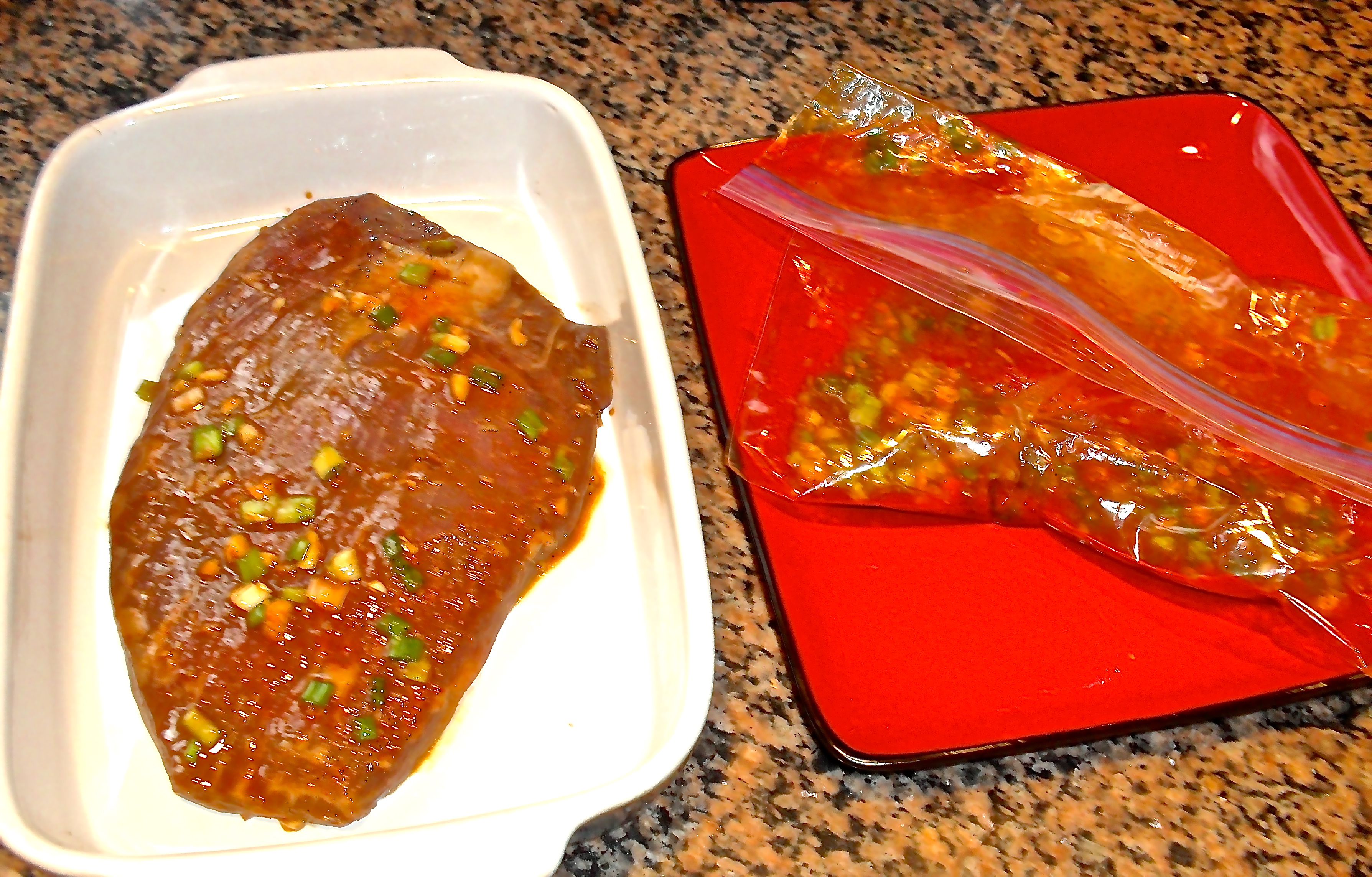
Next, remove the steak from the bag, and reserve the marinade in the plastic bag.
Place meat on microwave safe dish and blast it for 2 minutes, uncovered.
Calm down… It won’t hurt the meat.
Avoid plastic wrap, please. If you cover the dish, the meat will steam and give up too much of its juice.

Then, coat a heavy bottomed pan with 2 TBSP of oil (you chose which you prefer for searing in high heat. I like either olive oil or vegetable).

Crank up the heat, and when the oil starts to jump,add the meat. There should be an audible hiss as the meat hits the hot pan.
Sear on each side for 2 minutes.
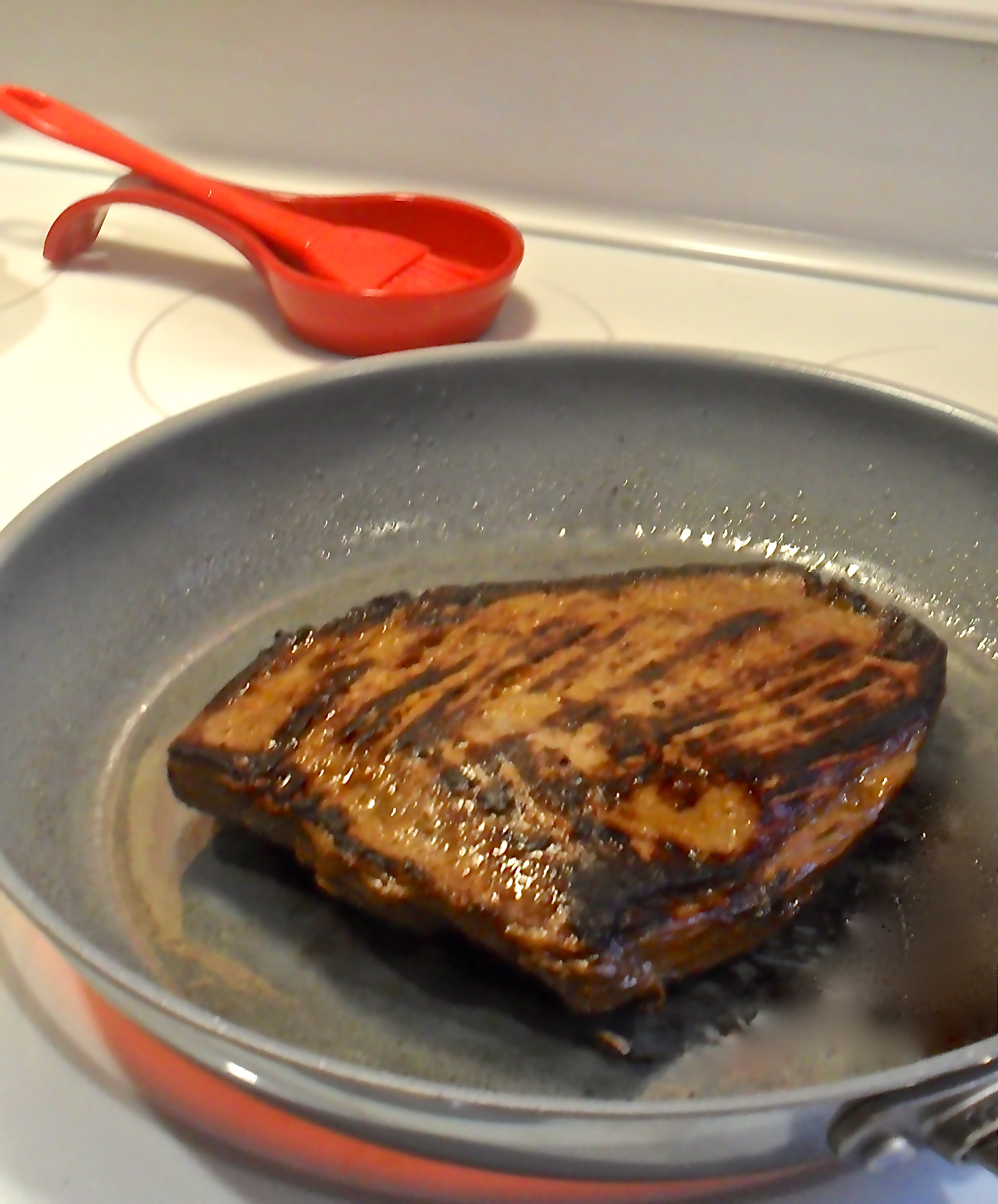
The meat will begin to shrink a bit, but good things are happening inside.
Remove the meat from pan and put it aside while you pour the remaining marinade from the bag, plus 2 TBSP of water, into the pan.
Lower the heat and let the sauce reduce for 2 minutes. If you wish, add more water. It will tighten up quickly.
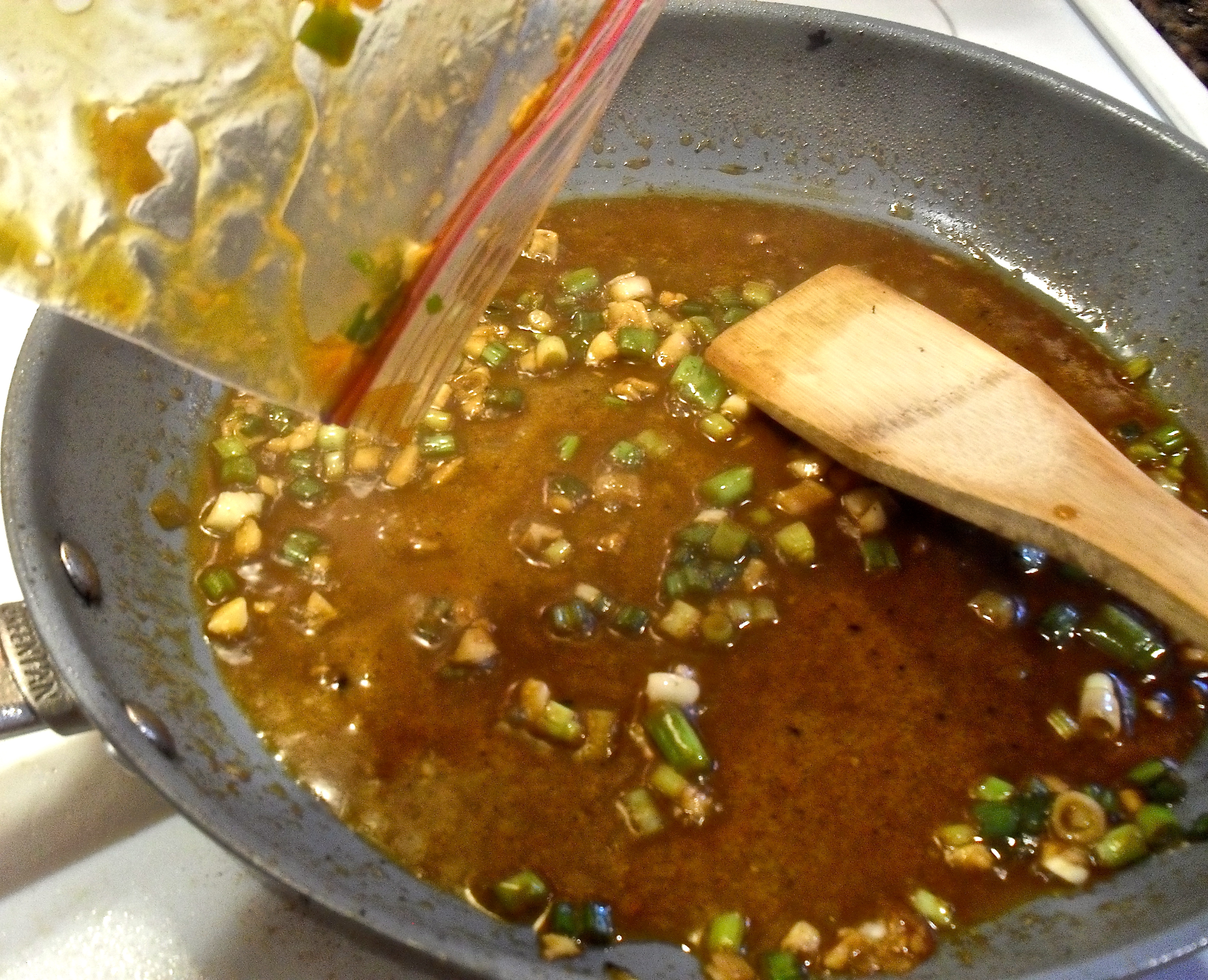
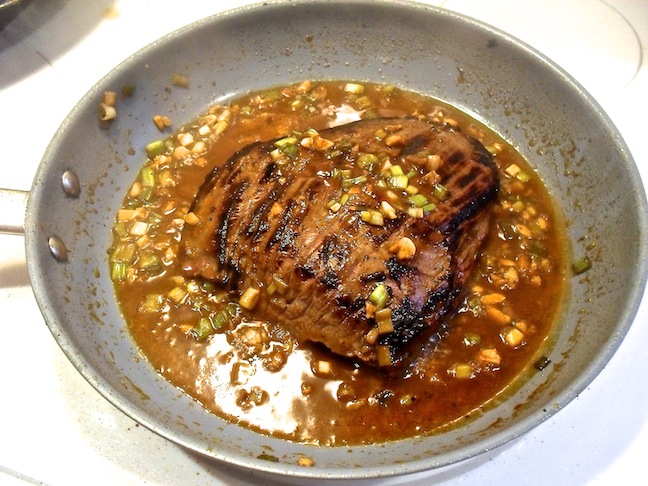
Return the meat to the pan and cook covered for…yup… 2 minutes (1 minute on each side).
Remove from heat, and let the steak rest for a good quarter of an hour or so. Then slice the meat on an angle, cutting across the grain.
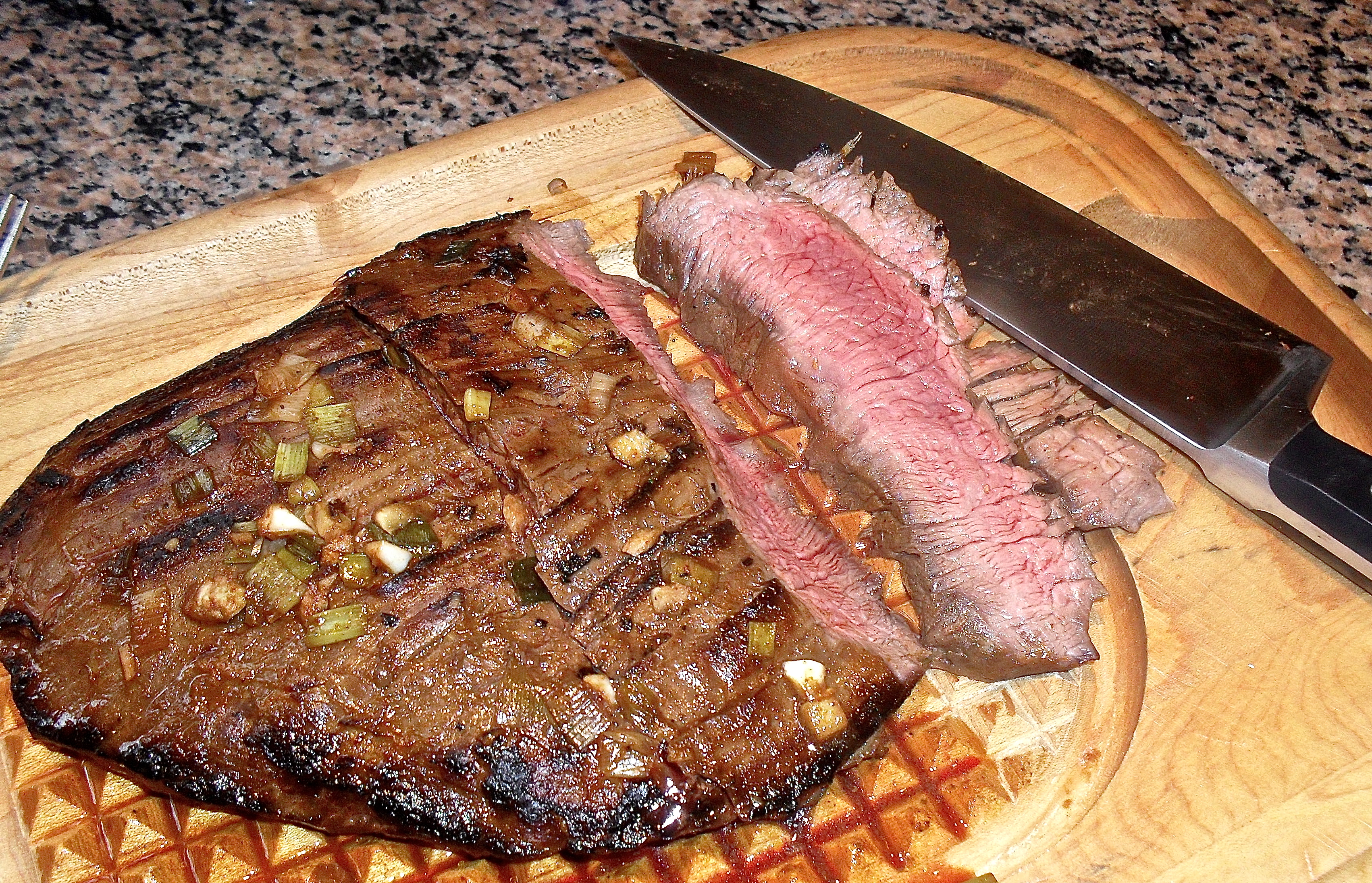
Juicy, tender, and very flavorful. Best served medium rare. And wonderful in sandwiches, too.
Got any ideas for sides? Tell us what you think would help round out this main dish.
====================
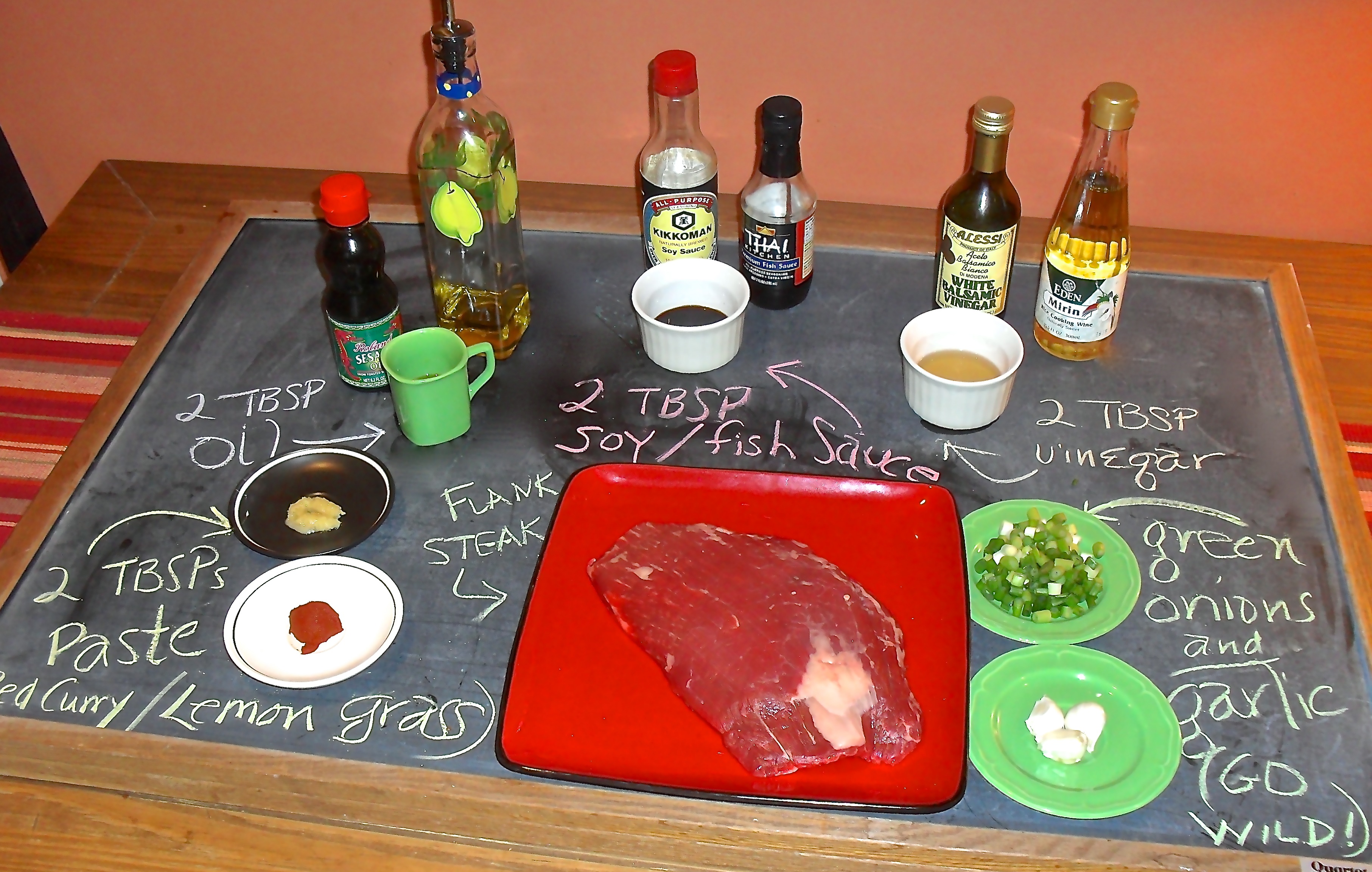
Recipe for Asian marinade: 2 Tbsp of oil (sesame or olive of combo of both), 2 Tbsp of vinegar (white balsamic or white rice or combo of both), 2 Tbsp of paste made from Thai red curry and lemongrass paste, 2 Tbsp of chopped green onions, 2 cloves of garlic or more, and if you wish, 2 tsp of brown sugar, 2 Tbsp of soy (but salt to taste is better, because soy is sometimes a little funky in a marinade, but that’s my POV). Stir well.
Kitchen Philosopher: The Cook as Scientist and Artist
Leave a commentThe Cook as Scientist and Artist
“Cooking requires confident guesswork and improvisation–
experimentation and substitution, dealing with failure and uncertainty in a creative way.”
–Paul Theroux
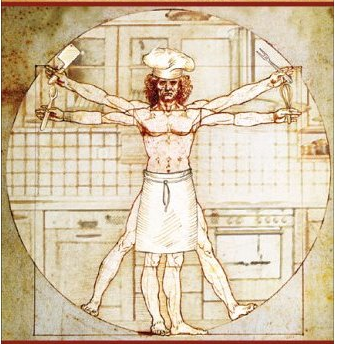
Book Cover, Da Vinci’s Kitchen by David Dewitt
Kitchen Philosopher: Live to Eat or Eat to Live?
Leave a commentAccording to one ancient philosopher, one should eat to live, not live to eat.
What’s the joy in that? Are these philosophical approaches mutually exclusive?

Optimal Heat Source for Optimal Cooking: Gas or Electric?
12 CommentsHome on the Range
Chef-friends and the clients for whom I cook have home kitchens which showcase heavy-duty cookstoves, stainless steel and copper-ornamented behemoths. They dominate the kitchen landscape and are the altar where the culinary clergy worship in the apse of their high-end kitchen. Their owners tell amusing stories about the nightmare installation involved in building their cathedrals of cooking, making for great table talk, but my romance with professional gas stoves ended a long time ago.
When my sister moved into her arts and crafts manse, she inherited an enormous Wolf range with six large burners, a griddle, and extra large oven. I fell in love with those red knobs and the clickety-click of lighting the blue flame, but soon held less affection for the required overhead vent– a monstrous and whirring dirt-attracting hurricane-inducing steel dynamo which still makes cooking there an unpleasant experience. Without fail, the smoke detector goes off, not from any smoke but from the shear heat output of simply boiling an egg, so the vent must always be used when cooking. The stove complex keeps her kitchen uncomfortably warm all year, the griddle pilot light cannot be turned off so the griddle surface remains very warm to the touch, and this professional machinery does not even have a broiler. Thoughts of removing the range and expert advice about doing so demanded a major de-construction and destruction of said stove just in order to get it out of the door. So she lives with it and has mastered its idiosyncrasies. It looks amazing in her large kitchen and never fails to impress as does her food.
Other reasons for my objection to such fancy fire sources are somewhat embarrassing, though logical: I am a bit of a neat freak.
Don’t get me wrong. I do a lot of home cooking, experimenting in the kitchen and entertaining; I enjoy making big time messes on a regular basis as I cook with abandon and on the client’s clock. But I accomplish all this on a flat-top ceramic electric model. (Please stop laughing now.) It comes with some nice bells and whistles, like a warming burner, convection oven, and more. When it comes to cleanup, I prefer a quick wipe of the sponge, a little scrubbage, and a few spritzes of Windex after which I can admire my reflection in the gleaming ceramic glass top.
I have no desire to pull apart heavy cast iron elements, to clean out blocked burners, or watch blackened grease build up on enamel and iron. When I had gas (usually in rented digs), I was constantly sniffing the air for leaks, fearing that I might blow myself up to smithereens out of carelessness or set the house aflame while I was away for long periods of time. I burned up my share of paper towels and oven mitts as well as ruined pots and pans in the early stages of learning to cook with gas. I watched mice scurry in and out of the burners en route to their nests under the sink. So when I bought my own home and had to make a choice, I chose a sophisticated electric model and had the gas line to the kitchen removed. Take that, mousies.
I know what they say: Electric heat is slower and less responsive. The direct heat of gas is best. You can’t cook with a wok on a flat-top. How can you char peppers? What about cast-iron skillets? Forget simmering at low temps on an electric stove! The best chefs use gas.
To this I say pish-posh. These points can all be argued. I admit, when storm Sandy hit the east coast, those lucky ducks with gas stoves still had a modicum of warmth and the ability to cook inside their homes. But we are talking about the art of cooking here, not cataclysmic concerns. Why is speed so important? Unless you are in an industrial restaurant kitchen setting, why should speed be at the top of the list. If you want speed, use a microwave.

Here’s my workhorse. Oo-la-la? Hardly.
I also admit that working with the flame of a gas stovetop has a nice primitive feel to it. It’s fun to play with the flame’s intensity. Bring out the marshmallows and peppers. Heck– why not a steak on a stick for that paleo vibe? There is a great joy in messing about with a direct heat source.
In the end, heat is heat, and once understood on your personal cooking device, can be controlled optimally. Learn to move pots and pans around. Take the numeric settings on your stovetop seriously and learn what they really deliver. Facts of cost, safety, and cleanliness depend on the individual. So why not try out different technologies throughout your cooking education?
I will always enjoy my charcoal Weber grill. I now can cook an entire Thanksgiving dinner on a wood-burning cast iron stove circa 1908 that lives in a shed in my backyard. And I will always prefer that iron monster to a high-end gas stove. Go figure.
Oh, and did I mention the cooking elements of the future? Induction? That’s right. A flat top burner that never feels hot to the touch due to the magnetic transference of energy directly to the pots and pans. You can put a towel under the pans to catch the splattering grease. Looks like the classic quandary may already be old hat. Then again, induction might just require an entirely new suite of cooking vessels. But that is another blog post.
–MELorden
So what do you all think? Share your experience and knowledge by leaving a response (Just click on the brown postage stamp in the upper right hand corner of this post).
Which is the optimal heat source when it comes to cooking? Gas or electric?
 outtathekitchen.com